
Heat Pump Maintenance, Common Problems, and What to Do If It Breaks
Heat Pump Maintenance, Common Problems, and What to Do If It Breaks
A heat pump is the only piece of equipment in your house that works in both seasons. It heats through our long grey winters and cools through August, which means it accumulates roughly twice the runtime of a separate furnace and air conditioner. Equipment that runs that much rewards attention and punishes neglect.
The US Department of Energy puts the gap between a well maintained heat pump and a badly neglected one at 10 to 25 percent of energy consumption. That is not a rounding error on a system that runs most of the year, and almost all of that gap comes from things that are cheap or free to stay ahead of.
What You Should Do Yourself
Change the filter. The Department of Energy recommends every three months as a baseline. In our climate, where the heating season is long and mild and the system runs many more hours than the filter label assumes, check it monthly and expect to replace it more often than the box suggests. A restricted filter is the single most common cause of the problems further down this page.
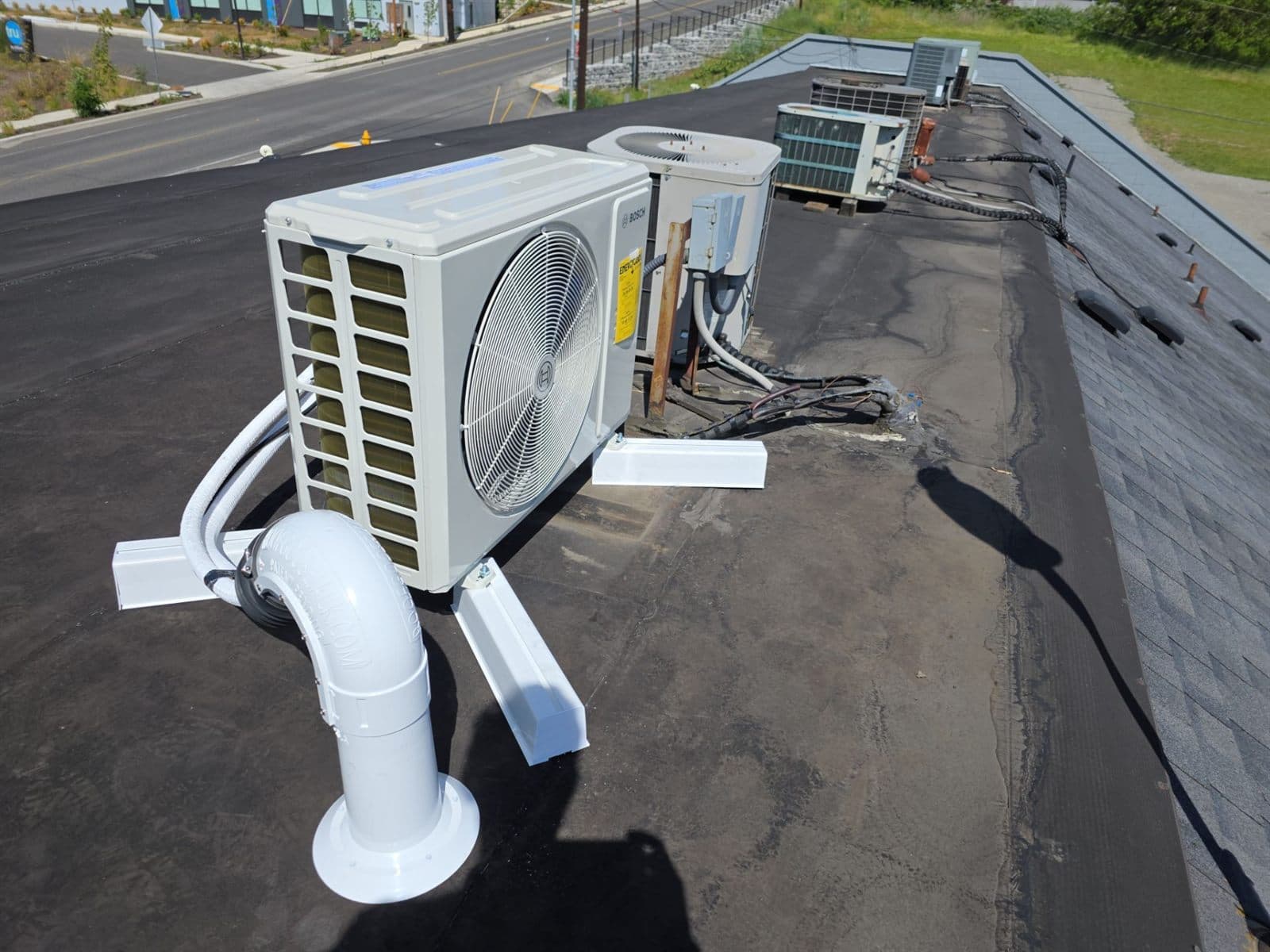
Keep the outdoor unit clear. Two feet of open space on every side, and nothing growing into it. Clear leaves, needles, and grass clippings, and cut back shrubs that have crept in over the summer. Turn the power off at the disconnect before you reach into the unit for anything.
Never cover a heat pump for winter. This is the mistake we see most often from homeowners who previously had air conditioning. An air conditioner sits idle from October to May and can be covered. A heat pump runs all winter, and covering it starves it of airflow at the exact moment it is working hardest.
Keep the base clear and draining. Our ground stays saturated for months. The unit sits on a pad for a reason, and a base that fills with leaf mulch and standing water leads to a coil sitting in ice and a cabinet that corrodes from the bottom up.
Rinse the outdoor coil when it looks dirty. Power off, garden hose, gentle pressure, straight through the fins rather than at an angle. Never a pressure washer. The fins are thin aluminum and bend permanently, and bent fins restrict the airflow you were trying to improve.
Go easy on the thermostat setback. This one is specific to heat pumps and it costs people real money. Dropping the temperature deep overnight forces the electric backup heat to run in the morning to catch the house up, and those resistance strips are among the most expensive heat you can buy. The Department of Energy is explicit about this: do not set back a heat pump thermostat if it causes the backup heating to come on. A few degrees is fine. Ten is not.
What the Annual Service Covers
Once a year is the minimum for a heat pump, and fall is the right time to book it, because heating mode uses components that cooling mode never touches.
A proper visit checks refrigerant charge, which is the item with the largest efficiency penalty when it is wrong in either direction, along with airflow across the indoor coil, the outdoor coil condition, the reversing valve that swaps the system between heating and cooling, the defrost control that keeps the outdoor unit from icing over, and the staging of the backup heat so it only comes on when it is genuinely needed. The technician also cleans the blower, tests the capacitor and contactor, tightens electrical connections, and confirms the condensate line is draining.
A heat pump that cooled perfectly in July can still fail on its first defrost cycle in November. The reversing valve, the defrost board, and the backup heat strips sit unused all summer, and a spring air conditioning check does not exercise any of them.
The Problems That Come Up Most Often
The air feels cool in heating mode. Usually normal, and usually one of three things. Heat pump air comes out around 90 to 95 degrees, which is cooler than skin temperature and feels lukewarm compared to a furnace, even when everything is working. It can also mean the system is in a defrost cycle, which lasts a few minutes. Or the thermostat fan is set to run continuously instead of automatically, so it blows unheated air between cycles. Set the fan to auto and see if it resolves. Genuinely cold air at every vent for a long stretch is a service call.
Ice on the outdoor unit. Some frost in damp cold weather is normal, and the defrost cycle should clear it every half hour to hour and a half. What is not normal is a unit encased in ice that never clears, or ice building up over the top of the cabinet. That points at a failed defrost control or sensor, low refrigerant, or blocked airflow. Never chip at the ice with a tool of any kind. The coil is soft copper and aluminum, and puncturing it turns a repair into a refrigerant leak. Switch to emergency heat and call.
It runs constantly. Long cycles are how heat pumps are designed to work, and a system running steadily during a genuinely cold week is doing its job. Constant running in mild weather is different, and usually traces to a dirty filter, a dirty outdoor coil, low refrigerant, or a system struggling against restricted ductwork. Start with the filter and the outdoor unit.
The electric bill jumped. On a heat pump this almost always means the backup heat strips are running more than they should. A deep thermostat setback, low refrigerant charge, restricted airflow, or a failed defrost cycle can all cause it, and the bill is often the first symptom you notice. This is the failure that is most expensive to ignore, because the system keeps you warm the whole time it is quietly costing you double.
It will not switch between heating and cooling. That is the reversing valve or its solenoid, and there is no homeowner version of that repair.
Water around the indoor unit. Usually a clogged condensate drain. Heat pumps produce condensate year round in our climate, so the line does not get a dry season to rest.
Noises. A whoosh or a clunk when the system changes modes is the reversing valve and is normal. Grinding, squealing, rattling, or a rapid clicking that repeats is not, and running the system through it usually makes the eventual repair larger.
Nothing at all. Check the thermostat batteries, then the breaker, and remember a heat pump has two disconnects: the breaker in the panel and a disconnect box outside near the unit. Reset a tripped breaker once. If it trips again, stop. A breaker that keeps tripping is reporting a fault, not being fussy.
What to Do When It Breaks
1. Check the free things first. Thermostat set to heat and the fan set to auto, batteries good, breaker on, filter clean, outdoor unit clear of debris and not iced over. A real share of no-heat calls end at one of those five.
2. Use emergency heat deliberately. Switching the thermostat to emergency heat runs the electric backup and keeps the house warm while you wait for service. It is expensive to run, so treat it as a bridge for a day or two rather than a fix, and tell the technician you have been running on it.
3. Do not do these. Do not chip or pry ice off the coil. Do not pour hot water over the outdoor unit. Do not keep running a system that is grinding or squealing. Do not open the electrical compartment.
4. Have the details ready when you call. The model and serial number from the nameplate on the outdoor unit, roughly how old the system is, what it is doing and when it started, and whether the breaker has tripped. It shortens the visit and sometimes means the right part arrives on the truck.
5. Ask about warranty before you approve a big repair. Most compressors carry a ten year parts warranty when the system was registered after installation. On a system under ten years old, that question is worth asking before anything expensive is authorized.
Repair or Replace
The honest version: repair almost always wins on a system under ten years old with a healthy compressor. Replacement starts making sense when the system is past twelve to fifteen years, when the failure is the compressor or the outdoor coil, when it uses a refrigerant that is being phased out and is getting expensive to source, or when you have paid for two or three repairs in as many years.
Efficiency is the part people forget in that math. A heat pump from 2010 that still runs is often significantly less efficient than a current model, so the comparison is not just repair cost against replacement cost, it is repair cost against replacement cost minus several years of lower bills and whatever rebates you qualify for.
The Short Version
- Filter monthly checks, replaced more often than the label suggests
- Two feet of clearance around the outdoor unit, and never cover it for winter
- Gentle hose rinse of the coil with the power off, never a pressure washer
- Shallow thermostat setbacks only, so the backup heat strips stay off
- Professional service once a year, booked in fall
- Frost that clears is normal; a unit encased in ice is not
- A sudden jump in the electric bill usually means backup heat is running when it should not be
- Emergency heat is a bridge to a service visit, not a repair
If your heat pump is icing up, running constantly, or costing more than it did last winter, our team works throughout Vancouver WA and the Portland metro area. Fall is the easy time to get on the schedule, and a heat pump that gets looked at before the cold arrives is a heat pump that is far less likely to need us in January.